Being raised as a Baptist, I know three things well:
1 – Potlucks will always have too many potato salads
2 – Catholics are amused by grape juice communion
3 – Summer camps
My dad’s employer had a camp reserved for them, and we went every year when I was a kid.
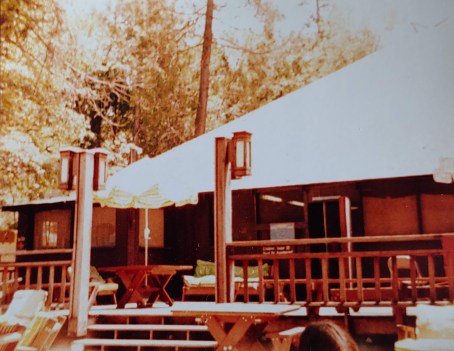
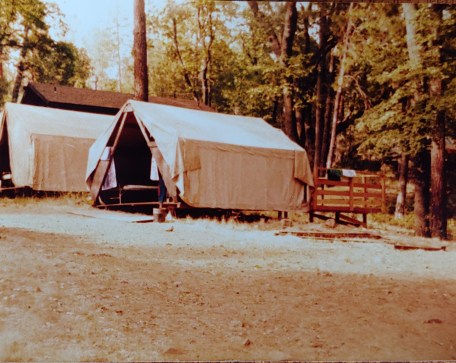
Now, when I say camp, I’d like you to imagine please the 1970s/early 1980s suburban camps, with hot meals in the dining hall, large patio with shuffleboard and ping pong. Our tents were wood frame “hogans,” basically a cabin with a canvas roof. Think Brady Bunch with fewer footballs to the nose.
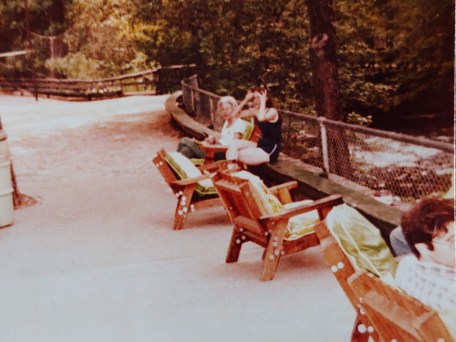
You probably can’t tell, but these are ancient family snapshots.
There was also a creek to swim in of course. Now, this is the Tuolumne River. If you aren’t familiar, this river is from snowmelt. It is clear, beautiful, and exactly as warm as you would imagine liquid snow to be. But it’s what we were used to and we loved it.
One time my sister and I were heading back to the “tent” for a reason lost in time. When we got there we flipped the door flap and there, hanging all upside down, was a teeny tiny bat having a nice snooze. In hindsight, he was perfectly adorable. But 9 or 10 year old me was not enchanted.
I screamed so loudly that the poor little fella sort of shook. The next morning at breakfast, as we all stood in the line for food (no bacon, will the suffering never end!) a few people in line were comparing notes about the piercing scream that came out of the woods the day before. Laughter and jokes commenced as I crouched down further into a metaphorical hole. Bev, as I recall, was zero help.
Lookit her…brushin’ back her hair all innocent-like.
Anyway, traumatized bats aside, it was fun to run around without supervision, to have a “summer boyfriend,” a local boy who once rescued me as my inner tube got caught in “rapids” that put me in very grave danger of bumping slightly into a rock and being annoyed. But I recall everyone on the river bank screaming and my hero running into the very dangerous rapids, grabbing my hand and pulling me slowly out of harm’s way. He was a dreamboat, I tell you.
And then we left and I never saw him again. Such is the life of a song from Grease.
These were good times.
When I was a little older, I went to a Music and Drama camp.
MAD camp was fun; I was around like-minded people, and I got to show off my voice. Next to writing, singing was my greatest joy. The councilors would choose a piece for us, we would practice and do a performance at the end when the parents got there, which was exactly as corny and wholesome as it sounds.
One year they chose “Godspell.” I loved this musical, and I was chosen to sing a solo of “Learn Your Lessons Well.”
Picture only, since I’m unemployed and don’t have money to pay a copyright lawsuit.
I know this song perfectly, I had sung it before. I figured I could work on other things and just ran the song through my head once or twice. Easy!
Here’s the thing though, this is a rapid, wordy song, there is little time to think. When I got up to sing it at the show I realized that thinking something is not the same as singing something.
I don’t have a clear memory of it except to say that my heart started to pound, my eyes bugged out an inch from my head, and the sweat poured off my body and made a pool on the floor as deep as our freezing cold river. Those last two may be exaggerations but only just.
I got through it. The director told me I repeated a couple of lines, but overall it went fine. My parents and friends said they had no idea that it had happened.
Many years later while I was studying opera (not as impressive as it sounds as I still don’t know how to read music,) I told my instructor about that, and he told me a secret.
When he was applying for his scholarship, he had chosen a song in German that he knew well.
He got up on stage, staring at the faces of the people who would decide if he could afford the Academy or not, and started to sing. Halfway through, his brain simply froze. He listened to the piano between verses hoping to jar his memory but…nothing. So he started to sing again on his cue and simply sang words that sounded vaguely German-ish but meant absolutely nothing. On the next verse he got his brain back from whatever frozen tundra of fear it had been hiding and finished the song perfectly.
He got the scholarship.
He had the opportunity to ask one of the professors how, exactly, had that happened? The seasoned performer told him, “Of course we knew what had happened. Of course we knew you were singing nonsense. But you did not stop. You filled that gap with words that fit the meter and sounded German, the average listener would never have known. Being perfect is advisable in performance, but being able to get past a mistake is truly impressive.”
“Being perfect is advisable in performance, but being able to get past a mistake is truly impressive.”
See? And I’ll bet you wondered how I was going to tie this into my intentions for this blog.
Both of us, in varying levels of importance, froze and could have failed. I did not practice, and he became overwhelmed with stress.
But we kept going and we got through and we did well; we did our best.
Whatever you’re doing, keep doing it. If you fall, that’s ok, get back up and keep going.
Don’t worry what anyone else thinks, because there’s a good chance they didn’t even see you skip a beat.
My sister and I have a shared memory that one of us remembers absolutely wrong.
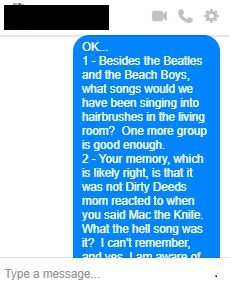
Bev is five years older than me, but we would still do things together growing up. One of the things we loved to do was put a record on the console hi-fi, (ask your parents) play a song and sing into hairbrushes, because hairbrushes are microphones, naturally. This would be to a song by The Beatles, or Journey, something we both liked.
I have a vivid memory of singing along to AC/DC’s “Dirty Deeds,” a fairly graphic song released in 1976 about a killer for hire. Our mom came in disgusted that they were glorifying murder like that. Bev looked at her and said, “Three words, mom. Mac. The. Knife.” This is a fairly graphic song released in 1959 about a killer for hire. Realizing she had no comeback to this, she turned and left the room.
I told that story to a group of friends recently, Bev among them. We all laughed because the opportunity to zing a parent like that is very rare and very funny.
But Bev frowned, “No, that’s not what happened.”
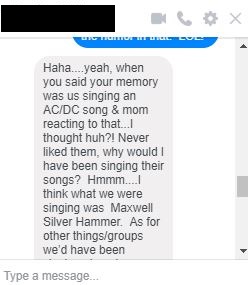
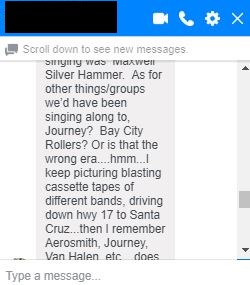
“We were in the car singing along to The Beatles, “Maxwell’s Silver Hammer,” on the radio. Everything else is the same, mom said that, I said Mac the Knife, all that, but we were in the car, and it wasn’t Dirty Deeds.”
I was flummoxed. “It absolutely was Dirty Deeds. We were in the living room like we always were.”
Then Bev made a very excellent point.
“I hate AC/DC, that’s your thing. I would never have sung along with them.”
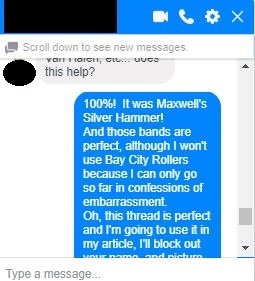
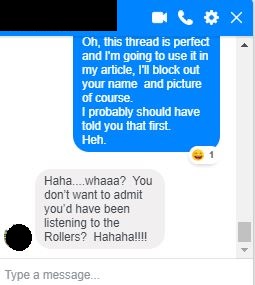
I do a lot of research for my articles. Sometimes it’s scholarly texts, sometimes it’s Facebook Messenger.
She is 100% correct, she does hate AC/DC, (on that point anyway, she is grievously wrong) so it is very unlikely my recall of this is accurate. But the thing that bothers me is, even after she described what likely happened, even after the completely reasonable argument of why it could not have happened my way, I still see it how I always have – living room, hairbrushes, AC/DC. One of us is simply wrong.
But neither of us is lying.
I am 100% certain that my version is right. I can see it, I can hear the song, our painful adolescent attempts to copy Bonn Scott’s un-copy-able voice, I can see the hairbrush in front of my mouth reflected in the living room window. I can see my mother pound into the room and angrily interrupt, and I can see Bev’s raised eyebrows and grin as she delivered the verbal body-blow that ended the argument.
I remember it exactly like that.
Except I am more than likely, 100% wrong.
It seems like a contradiction, but it’s really not. I’m not lying when I say I see that scene play out exactly as I describe.
In preparing this article, I spent some time talking to my psychiatrist about the implications of memory fluidity. I had to come to peace with my own issues around this before I could try to offer any comfort to you. But she has, as always, helped me work through it.
Because that’s really the thing, isn’t it? That’s the easiest way to dismiss an accusation, to devalue an experience, especially if it happened long ago, in childhood, teenage years, is to simply say, memory is fluid, you have a vivid imagination, you saw a TV show and made it real in your head, etc. until no one believes it, and eventually, maybe you don’t even believe it.
Memory is fluid, eyewitness testimony is one of the least reliable, that is a fact. But what does that mean for survivors?
I used the example with my sister because it’s funny, and I wanted to work into this a little gently. But it is also apt. I remember it exactly as I always have. I don’t remember being in a car. I don’t remember Maxwell’s Silver Hammer. I remember the living room, hairbrushes, and AC/DC. I am likely completely wrong.
But, and this is important, I am wrong about the details, the where, when, what song, but I am right about the important part of the story. A taboo song, a mother trying to shut it down, Bev winning the argument before it even started. We are in complete agreement about these details.
The actual, important event, is correctly remembered.
This is important to me because memory has played such a critical role in my “story” and even my identity.
I was abused by various people, including a brother, throughout my childhood. I have no memory of not being angry, of not feeling rage and fear and blinding, white-hot hatred, for him. I remember specific events.
I have identified as a survivor since my 20s. When the book “The Courage to Heal” came out, it was a revelation. I was validated, seen, and I was not alone. I remember going to an all-day event and watching women much older than me walking from lecture to lecture carrying stuffed comfort animals. I remember wishing I’d thought of it, and realized that I would not have had the courage to carry it in public if I had. Allowing myself the self-care I needed was nearly two decades away. But here I had a community, a large group of kindred spirits who had been victimized to one degree or another, all equally valid, all worthy of love and care.
I remember sitting alone at the lunch break and falling to pieces. All of these women are here for each other. All of these women are here for each other, because all of these women have been brutalized and broken, to some degree or another. I felt hurt, wounded, exposed, and heartsick.
In the coming years I came to terms with my alcoholism, my depression, and finally landed the correct diagnosis of bipolar II, which became bipolar I a few years later.
But the abuse, that was first. That was in the late ‘80s with the release of that one book, the first time I heard the term “survivor.” And I am forever grateful to Ellen Bass for that.
When my father confronted my brother after I’d spent a horrible afternoon telling my parents what had happened, dad asked him why he did it. Dad told me later that he hung his head and said, “I don’t know.”
“I don’t know.” These are not the words of an innocent person. The words of an innocent person are, “What are you talking about? How dare you! How dare you accuse me of something so horrific! So vile! How dare you!”
With that tacit confession, I should have no longer doubted what I recalled.
“I hate AC/DC. It was in the car, not the living room.”
It’s not only a single detail being confused here. It is the entire scenario. Except for the “punch line,” every single thing I recall is wrong.
How would you describe this in 20 years? Are there stairs leading to a doorway? Chipped paint on the ceiling? What color was it, what color was the sky? But it took your breath away, that you won’t forget.
I have my memories, and more importantly, I have an admission of guilt and diaries and poems that go back to nine-years-old. I have “source material,” if you will.
And even still, I had doubts sometimes.
What of the women who don’t have anything but their memories? What of the women for whom this is a “he said/she said” situation?
What of the women who completely and utterly disassociated while it was happening, to the point that it’s a black nothing in their memory? Don’t think that’s possible? Here’s another story.
When I was 16, I bought my first vehicle, a yellow Toyota truck with a camper shell. I took it out for a spin with several of my friends, laughing and having fun in the back of what was basically a playhouse for teenagers.
I was on a four-lane street with a large grassy median.
Here’s what I remember next. A car swerved in front of me within inches of my fender. I remember seeing the jackass in the back seat turn around laughing as I tried to keep control. Next, I was on the median, the entire left side of my truck on the curb, my rims had bent and ripped my tires to shreds. My friends were trying to open my door and get me out. When I came to, when I started to get my higher functions back, my hands were so tightly gripped on the wheel that I could barely remove them, and I was aware very slowly of the shooting pain up my arms as I had apparently used them as shock absorbers during the crash. My friends finally coaxed me to unlock the door. I got out, lost control of my legs, fell to the ground, and just…shook.
My friends said I was amazing, I kept control of the truck, I had no choice but to crash the way I did, but I skidded along on my rims and came to a safe, controlled stop.
To this day, I have zero memory of any of that.
My brain simply went on some sort of autopilot, I guess literally this time. It was so horrible that my memory said “Well, I’m out. I’ll be back here with Smell until this is all done.”
This happened during a car accident. Imagine what our brains can do when we’re being raped, abused, beaten, molested, imagine how far away we can leave our brains and hide, or even rewrite, something life-shatteringly horrible.
Memory can get muddled, that’s a fact. Those of us who are survivors become extremely good at disassociation. I have been a pro since I was a child; it’s an escape, it’s a world you control, you are essentially a god. It can also make for a rich creative life.
But these things can be, and are, used against us. How do we know what is real? How do we know what really happened, was is AC/DC or The Beatles? Is it a total blackout from mental self-defense, did it spring from a vivid imagination?
I can’t answer these questions for you but I can tell you this.
My memories are real. Maybe not minute details, maybe not the room, the surroundings, the time of day. But the events – what actually happened – are drilled into my head. The more traumatic the event, the more likely we remember. Or sometimes it simply never writes to memory. Like my accident, that 3 or 4 minutes is not there.
I have the details surrounding the event wrong. It was The Beatles, it was in the car, this could not be more different from my memory. But the core of it, the actual, meaningful event, was correct.
Friends, men and women alike, if you have a memory of abuse, if that memory causes your heart to hurt, I suggest that it is probably correct. At the very least it should be examined, try to find a therapist to help you work through it. I’m including some resources you can use as well.
Please, do not let anyone tell you it’s not true, you are misremembering, or worse, that you are lying. If it hurts to think about, look at it.
Memory is foggy and imprecise. But it is not to be ignored because the curtains were blue and not yellow.
Please take care of yourselves. Be gentle with yourselves.
Carry a stuffed comfort animal if you need to.
National Helpline
SAMHSA’s National Helpline is a free, confidential, 24/7, 365-day-a-year treatment referral and information service (in English and Spanish) for individuals and families facing mental and/or substance use disorders. https://www.samhsa.gov/find-help/national-helpline
We can all help prevent suicide. The Lifeline provides 24/7, free and confidential support for people in distress, prevention and crisis resources for you or your loved ones, and best practices for professionals.
I know this is off schedule on a Friday, but since my goal with this blog is to raise awareness of mental illness, to support others dealing with it, and to kick stigma in the face, I really can’t go without mentioning it.
You know what I think?
My illness does not define me. It’s part of me, it always will be, but it is not the boss o’me! And yours isn’t either. I’m gonna fight and I’m gonna laugh, and I’m gonna spell words wrong because it’s funny to me.
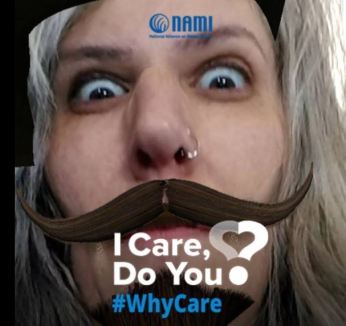
I added a frame to my personal Facebook profile picture. I thought about changing the photo to something a little bit less…disturbing. But I did not because the picture is funny, and that’s what I’m going to do, I’m going to flip my bird at bipolar and live my life the way I do.
I will make myself look ridiculous for the funny. Heck, I’ll hurt myself slightly for some quality slapstick.
Do you know how strong you are because you got out of bed this morning? Because you face each day the best you can and you keep going and you find beauty and laugh because there are goats? (That may just be me.)
You are a warrior, a lion, a superhero, whatever image speaks to you.
I am going to continue to laugh at pretty much everything, talk to people in my real life, and write this blog, it helps me and I hope others find something they can use here too.
Anyway, that’s about it. Be strong and when you feel overwhelmed, please seek help.
I’m listing some links for you from Mental Health America and NAMI where you can find information, resources, banners, and frames if you are comfortable using them.
Remember –
Hiding is exhausting, fear is debilitating, and shame is just plain bullshit.
When I am writing something, the forward in my book, a new poem, this article, sometimes I get stuck. If I’ve reached a point where my fingers hover over my keyboard and sort of wiggle in mid-air with no real idea where to land, I open a new document and start to free write.
Free writing means I simply type and do not stop. If I hit a wall, I write something like “damn I hit a wall what shall I write about now I had a carrot yesterday the color orange is funny what hell is Crazy Legs up to out there…” or just one word over and over. The point is to keep writing, keep focused, don’t edit.
Hidden away among those carrots and cats, I usually find something real, however small, since my brain did not have time to block it. It may be a creative idea to expand on, the break in the dam that sends the water roaring down.
Or it may be truly enlightening.
Alone with my thoughts, I can write nonsensical ramblings that only I will see. But there also may be the inadvertent slips of sometimes brutal insight.
Then I get to my therapist’s office.
It’s a quirk for me that I want to sound smart and well-spoken with the current keeper of the “I can send you to a 72 hour hold,” so I choose my words carefully. I’m so super smart! You don’t know how many thoughtful things I can say with my face-hole! So a lot of time is wasted on long pauses while I try to find exactly the right word, the cleverest turn of phrase. (I also feel weird if I don’t make small talk when I get there, but that’s just my usual neurosis.)
Anyway, I told her that I wanted to try an experiment. In order to get to the heart of the matter I was going to free write verbally, without a “watcher” in my head, an inner critic, any sort of a barrier to raw truth.
It goes like this, start talking, that’s it. Just open your mouth and say things with your lips. Do not edit for grammar or vocabulary or syntax, just talk. You will almost certainly hit on something. And when you do, stand up and shout “Eureka!” (totally don’t do this.) When you hit on something, stop and look at it.
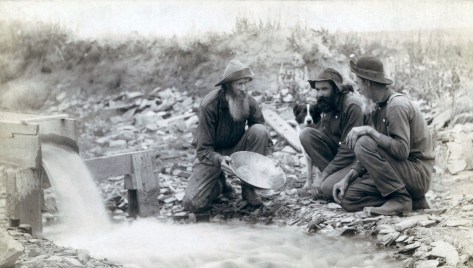
The process of healing is sifting through the dirt until you find gold. You will find a lot of “fool’s gold” in the process, but if you can get through that dirt, if you can sift out the bugs and rocks, you can hold a nugget of gold in your hand and know you’ve accomplished something.
Therapy is old timey gold prospecting, apparently. I shouldn’t watch documentaries before I write these.
“So you see Jeremiah, if you sort through these dad-burn bugs and confounded rocks, you can find bits of evocative insight!”
Anyway, I encourage you to try it, both written and verbal. It cuts through the long pauses where we sometimes obsess about how to present ourselves in the best light. You don’t have to impress them. You’re in therapy, not on a date.
Also, you don’t have to make small talk. “Hi how are you?” will generally suffice. I’m still working on that one myself.
There are so many good tools to use for self-care, like painting, hiking, meditation, cooking. These are all wonderful. They focus the mind on a single activity, put issues on a temporary time out, and provide goals to reach. I enjoy all of these minus the cooking. My husband keeps me alive with foodstuffs.
I want to focus on one particular tool, journaling. I have kept a diary (called a journal when you’re over 19 maybe 20, not sure why) since I was eight years old. I have many volumes of hand-scribbled books, with covers of puffy stickers to unicorns to Celtic designs.
I leaf through the pages and find the traumas I survived, some of which I don’t remember, many that I do, and I shake my head that I am still alive. There are joys I can relive, and little treasures I stuck between the pages. Some of them take me to a time and place, others had a meaning that is long lost. Whatever it was, younger me loved it enough to tuck it away, so I leave it where it rests.
See, it is your most private sanctuary, it is yours to express yourself however makes sense to you. Record the events of the day. Write your dreams. Draw pictures, watercolor, tuck things inside that are meaningful to you.
Can’t draw? Can’t paint? So what! Does the act of drawing or painting or whatever make you happy?
Do you see that picture right there? The blonde lady with floating bubbles and what appears to either be a yellow aura or she’s standing in front of a blinding light bulb? The one pained by someone who has apparently never seen a human body before? I painted that! That’s my painting! And it is objectively horrible! But I love it. I love coming into my studio, gathering my brushes, putting up a canvas and playing artist. It’s living a dream for me. It just makes me happy, and that’s enough.
What about you? Do you give yourself permission to play?
If a unicorn journal made you smile, would you buy it?
There is a truism I have found in life. People tend to restrict themselves with “I can’t because”…I’m an adult, I’m a professional, it would be stupid…I respectfully disagree.
Here’s the thing…I have a very large collection of a certain mouthless white kitty (I don’t want to get sued.) I get annoyed if someone refers to her as “it.” I have only one drawer left in a 6 drawer chest for clothes. I’m 50.
She makes me happy, and that’s enough.
So please, go out and do something that makes you happy. If you are in a depression this will seem Herculean, but if you can, walk to the sidewalk. Then another day to the end of the block. And celebrate each accomplishment. You are awesome! You did it!
If you can’t, truly can’t, then find a pen and some paper, and try to spell out what you feel. It really does help.
Or paint a picture like my malformed bubble lady, which I did while deep in the bowels of a pit. Because now it makes me laugh, it makes me happy.







 appears to either be a yellow aura or she’s standing in front of a blinding light bulb? The one pained by someone who has apparently never seen a human body before? I painted that! That’s my painting! And it is objectively horrible! But I love it. I love coming into my studio, gathering my brushes, putting up a canvas and playing artist. It’s living a dream for me. It just makes me happy, and that’s enough.
 Nightmares and Laughter